
Eight Man (1991): SNK’s Fast-Paced Cybernetic Arcade Classic
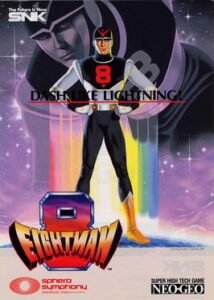 Introduction: A Forgotten Arcade Hero Worth Remembering
Eight Man is one of those early 90s arcade games that doesn’t always get brought up in mainstream retro gaming conversations, yet it carries a distinct identity that makes it memorable once you’ve played it. Released in 1991 and developed and published primarily by SNK, the game delivers a fast, no-nonsense action experience built around a cybernetic hero fighting crime in a futuristic world.
At a time when arcade cabinets were everywhere and competition was fierce, Eight Man stood out by focusing on speed, simplicity, and style. It may not have reached the cultural status of something like Superman in superhero storytelling, but within its own lane, it carved out a solid place in early Neo Geo history.
SNK’s Role: Building an Arcade Identity
To understand Eight Man, you really have to understand SNK. During the late 80s and early 90s, SNK was aggressively shaping what arcade action games could feel like. They weren’t just building games—they were building a reputation for tight controls, fast gameplay, and high replay value.
With Eight Man, SNK leaned into those strengths. The goal wasn’t complexity or deep systems—it was about delivering a punchy, responsive experience that kept players feeding coins into the machine. That philosophy is obvious the moment you start playing.
On top of that, Eight Man also fit into SNK’s growing Neo Geo ecosystem, which was becoming a major force in both arcades and home gaming.
The Universe: A Cybernetic World of Its Own
Unlike games tied to massive shared universes like Marvel or the DC Universe, Eight Man exists in its own self-contained world inspired by the Japanese manga hero “8 Man.”
The setting is a classic cyberpunk future—crime-filled cities, advanced technology, and a society where humans and machines are increasingly blurred together. Instead of gods or aliens like Superman, the hero here is something more grounded in sci-fi: a human transformed into a cyborg law enforcer.
That idea is really what gives the game its personality. Eight Man isn’t about saving the world in a cosmic sense—it’s about enforcing justice in a cold, mechanical future where humanity and technology are constantly colliding.
Gameplay: Simple, Fast, and Straight to the Point
At its core, Eight Man is a side-scrolling beat ’em up, but what makes it interesting is how much emphasis it puts on speed. The protagonist doesn’t just walk—he moves with exaggerated acceleration, almost like he’s designed to break through the screen.
Combat is straightforward: punch, kick, and push forward through waves of enemies. There’s no complicated system to learn, which actually works in its favor. Instead, the focus is on rhythm and momentum. You’re constantly moving, constantly attacking, and constantly reacting.
As the game progresses, things get more intense. Enemies come faster, hit harder, and force you to stay sharp. It’s the kind of design that feels very arcade-first—meant to challenge you just enough to keep you trying again.
Release Details and Platforms
Eight Man was originally released in 1991, during a period when arcade gaming was at its peak and developers were experimenting heavily with hardware capabilities and gameplay styles.
The game was primarily released across arcade systems, specifically SNK’s Neo Geo MVS platform, which powered arcade cabinets around the world. From there, it also made its way to home systems in the same ecosystem, including:
- Neo Geo AES (home console version)
- Neo Geo CD
- Arcade machines (Neo Geo MVS hardware)
This dual presence in arcades and home setups helped Eight Man reach a wider audience than many smaller arcade titles of its time.
Visual Style and Sound: Pure Early 90s Energy
Visually, Eight Man leans heavily into a cyberpunk aesthetic. You get industrial environments, metallic structures, and enemies that feel very mechanical or exaggerated in design. The sprite work is detailed for its era, even if it doesn’t try to push realism.
What really stands out is the character design of Eight Man himself—sleek, armored, and built to look fast. Everything about him visually reinforces the gameplay idea of speed and momentum.
Sound-wise, the game does exactly what it needs to do. Effects are punchy, hits feel impactful, and the music keeps a steady high-energy rhythm that matches the constant action on screen. It’s not trying to be subtle—it’s trying to keep you engaged.
Reception and Long-Term Legacy
When Eight Man launched, it didn’t become a massive breakout hit, but it did find its audience among arcade players who appreciated fast, uncomplicated action games. Over time, it became one of those titles that retro fans rediscover and appreciate more in hindsight.
Part of its charm is how clearly it represents its era. Early 90s arcade design wasn’t always about polish or narrative depth—it was about immediacy. And Eight Man delivers exactly that.
Final Thoughts
Looking back, Eight Man is a great example of early 90s arcade design philosophy. Developed and published by SNK, released in 1991, and built for the Neo Geo arcade and home platforms, it doesn’t try to be anything more than a fast, stylish action game—and that’s exactly why it works.
Its cybernetic hero, original universe (separate from franchises like Marvel or DC), and straightforward gameplay make it a solid snapshot of its time. It may not have the name recognition of bigger titles, but it still holds value for anyone interested in arcade history or SNK’s early output.